
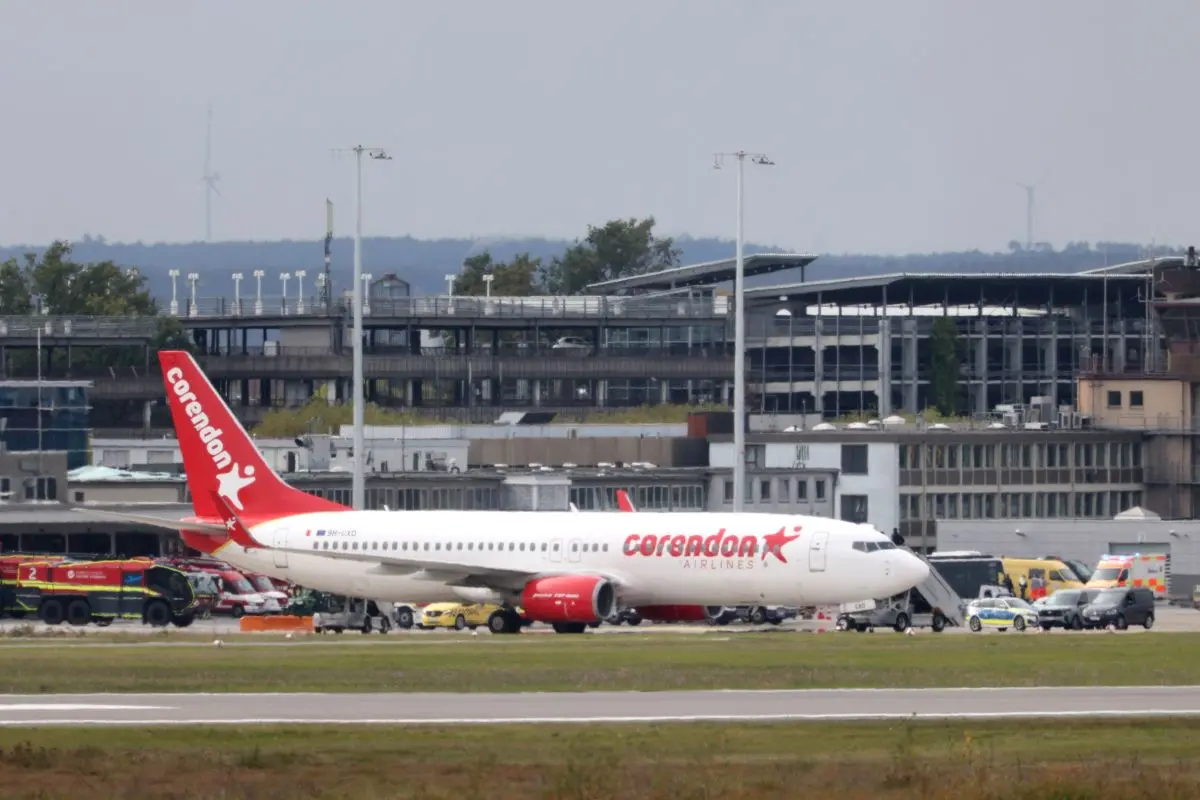
A Corendon Airlines flight from the Greek island Corfu to Nuremberg sent out a hijacking alert to several European countries Tuesday, prompting fighter jets to be scrambled and a temporary closure at Albrecht Dürer Airport Nuremberg.
After emergency response protocols played out and the aircraft was safely on the ground in Nuremberg it was determined that the alert had been a false alarm -- there was no real threat.
German police said, the aircraft had "inadvertently" transmitted the alert, adding that "the aircraft could no longer be reached by radio to clarify the situation."
The scare came at a time when European authorities are on high alert, especially regarding airport security.
About two weeks ago a real hijacking attempt on a Flydubai flight headed to Tel Aviv was only narrowly prevented by the heroic acts of a pilot on board.
Also early on Tuesday morning, just hours before the incident, air traffic in and out of Nuremberg was briefly disrupted due to a drone sighting nearby.
The response
After the distress call was received and authorities failed to contact the flight's pilots, a Rafale fighter jet was scrambled from Croatia to intercept the Boeing passenger jet while the German military also dispatched warplanes.
Military aircraft closely accompanied the passenger jet in Croatian airspace and made visual contact. They noted that no abnormalities were observed in the cockpit, air traffic control said afterwards.
Still, the all-clear could not be given. In German airspace, Eurofighter fighter jets accompanied the aircraft to Nuremberg.
Nuremberg airport suspended operations and police were deployed to the scene. They were waiting for the passenger plane on the runway when it arrived.
Police inspected the aircraft and found there was no danger before it was allowed to dock and passengers to disembark. Further investigations into the incident will follow.
READ ALSO: Ryanair scraps all flights from Bremen airport from spring 2027
Why was the alert sent?
According to reporting by DPA, the airline had issued a code "7500" alert, which is said to be one of the most feared warnings in international air traffic.
The code signals "man with knife", and is a common warning for a possible airplane hijacking.
Other air emergencies are 7600 for radio failure, or 7700 for an air emergency. There are also codes for medical emergencies, technical defects or fuel shortages are also covered here.
A spokesman for German air traffic control told DPA that there are several possible ways a false alarm could be triggered, beside it being sent by the pilots. However, they have no way of retrieving or undoing an emergency code once it has been sent.
According to the police, because the plane could no longer be reached by radio after the signal was given, the responsible authorities had to assume the worst and close the airport and alert forces in Croatia, Austria and Germany.
So far police assume the radio onboard the Boeing 737 was defective.
The emergency code is not transmitted to the ground via radio, but by keystroke input via a transponder.
Besides alarms, the device is used to uniquely identify an aircraft as it moves and is mandatory for passenger jets.
IN PICTURES: Six hundred sheep are led through Nuremberg's city centre
With reporting by DPA and AFP.
Comments